The Art of the Prompt: How Generative AI is Changing the Creative Industry
Explore how prompt engineering and generative AI are transforming the creative industry, shifting production from manual execution to conceptual direction.
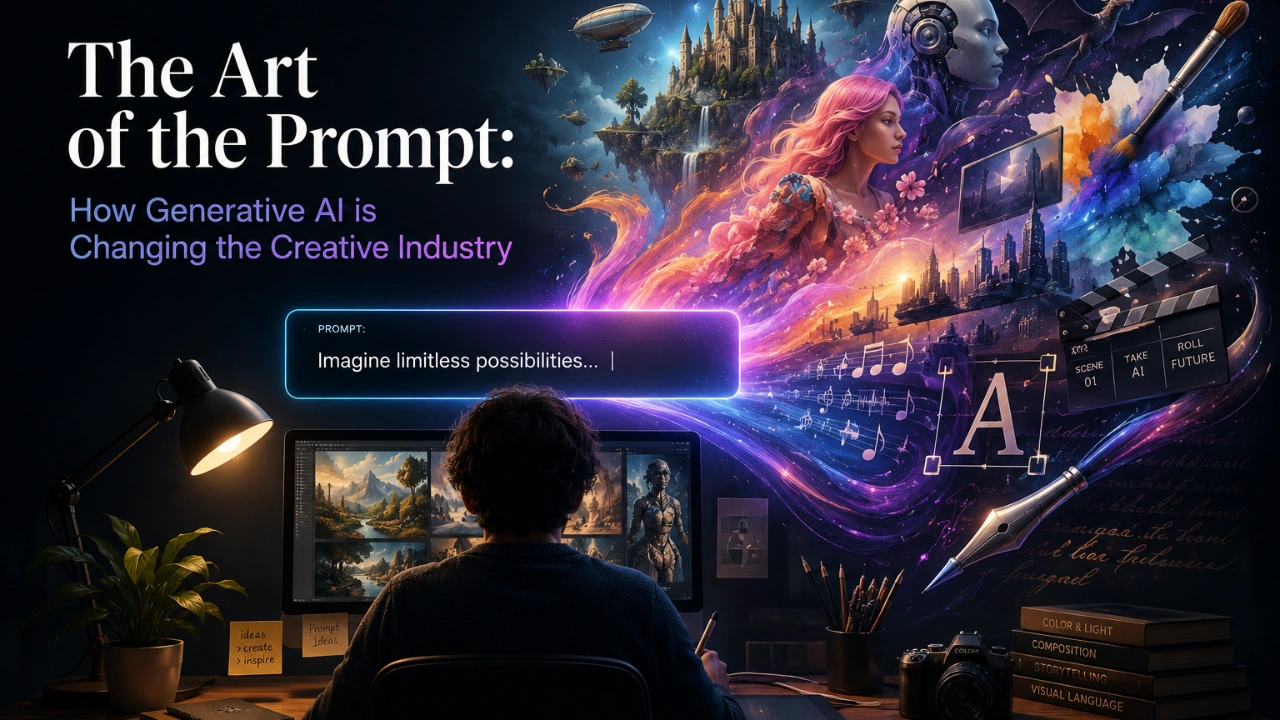
The Art of the Prompt
The Art of the Prompt: A massive, paradigm-shifting transformation is sweeping through the global creative ecosystem. For generations, the line separating human artistic expression from machine automation was considered completely uncrossable. Machines were celebrated for their ability to process massive datasets, calculate complex logistics, and execute repetitive operational tasks with flawless mathematical precision. True creativity, however—the ability to conceptualize an evocative visual landscape, compose a moving piece of music, or write a compelling, deeply human narrative—was viewed as the ultimate, exclusive domain of the human spirit.
That line has not just blurred; it has been entirely redrawn. The rapid ascent of advanced generative Artificial Intelligence (AI) models, large language models (LLMs), and neural network image generators has fundamentally turned the traditional creative process upside down.
Instead of replacing the human creator, this technology has birthed an entirely new form of creative expression and a highly demanded professional skill set: The Art of the Prompt.
We are moving away from an era where technical execution (knowing how to manually code every line, mix every sound wave, or physically paint every shadow) was the only barrier to entry. We are entering an era of conceptual dominance, where the ability to direct, converse with, and precisely guide an intelligent digital canvas is becoming the ultimate superpower for content creators, designers, and developers worldwide. In this deep dive, we will explore the mechanics of prompt engineering, analyze how it is reshaping creative workflows, and look at the future of human-machine collaboration.
The Shift from Technical Execution to Conceptual Direction
To truly understand how generative AI is transforming the industry, one must analyze how the creative bottleneck has shifted. Historically, if an independent creator wanted to bring a complex visual concept to life for a lifestyle feature, a promotional banner, or a digital story, they faced a massive execution gap. They either had to spend years mastering intricate design software, or allocate a substantial financial budget to outsource the work to specialized production houses.
Generative AI has bridged that execution gap completely. When a creator interacts with a modern AI model, the machine handles the heavy, computationally intensive labor of generating the final pixels, structuring the foundational code, or drafting the initial prose.
Also read: How to Use Gemini to Customize and Elevate AI-Generated Video Characters
The human partner’s role transitions from being a manual laborer of the medium to a Creative Director. The creator’s ultimate tool is no longer a physical brush or a specific software shortcut; it is their vocabulary, their understanding of artistic history, and their ability to frame an idea through a highly structured text prompt.
Decoding the Anatomy of a Masterful Prompt
A common misconception among casual observers is that generative AI makes creation “too easy” or removes the need for human skill. However, typing a generic sentence into an AI tool almost always yields a generic, uninspired, and “robotic” output—the exact type of low-value content that fails to engage modern readers or clear strict web quality reviews.
True prompt engineering is a highly sophisticated art form that combines linguistic precision, structural logic, and deep cultural knowledge. A premium, production-grade prompt does not just ask for an asset; it deliberately builds a multi-layered creative framework. Here are the core components that elevate a basic input into a masterful prompt:
1. Clear Role Definition and Contextual Persona
Before assigning a creative task, a master prompter explicitly establishes the AI’s identity and operational boundaries. By instructing the model to act as a “seasoned cultural journalist,” a “senior UI/UX frontend engineer,” or an “expert avant-garde photographer,” the user forces the underlying neural network to prioritize specific stylistic tones, professional vocabularies, and precise quality standards buried within its training data.
2. Stylistic Archetypes and Historical Referencing
Vague descriptors like “make it look beautiful” or “write a cool article” mean absolutely nothing to an algorithm. High-tier prompts leverage concrete historical and stylistic references. A designer might reference specific lenses, lighting configurations (e.g., “cinematic golden hour volumetric lighting”), or artistic movements (e.g., “mid-century modern minimalism”). A writer might specify structural formatting constraints, semantic pacing, or the deliberate removal of overused corporate clichés.
3. Iterative Feedback Loops (The Human Polish)
The finest AI-assisted creations are almost never the result of a single prompt. They are forged through an intense, back-and-forth conversational dance. The creator reviews the initial output with a highly critical, human eye, spots the structural flaws or emotional blind spots, and feeds precise refinement prompts back into the system—adjusting contrast, shifting narrative focus, or injecting authentic human warmth until the final product feels genuinely original.
Enhancing Content Workflows Without Losing the Human Touch
For website administrators, publishers, and independent content creators, generative AI tools have become the ultimate productivity multipliers—provided they are used ethically and intelligently. The goal is never to let the AI do the thinking; the goal is to let the AI accelerate your unique vision.
-
Dismantling Writer’s Block: AI models are exceptional brainstorming partners. A creator can use them to generate 20 unique angles for a lifestyle topic, map out comprehensive structural outlines, or cross-reference historical data points within seconds, drastically cutting down early-stage research friction.
-
Elevating Scannability and Structure: Modern web readers demand clean, highly scannable layouts. Creators leverage generative tools to format dense human research into beautifully structured Markdown components, custom comparison metrics, and targeted meta descriptions, ensuring the final asset is highly optimized for both search engine crawlers and human readers.
-
The Absolute Necessity of Curation: The most critical stage of the modern workflow is the human curation filter. AI can generate data, but it lacks human lived experiences, emotional empathy, and authentic wit. A true professional treats AI text as raw clay—uniquely shaping, rewriting, and injecting personal voice, local cultural context, and real-world expertise to ensure the final piece resonates deeply with the community.
In Short: The Co-Pilot Era of Creativity
The rapid rise of generative AI does not spell the death of the human creator; rather, it marks the dawn of an incredibly exciting co-pilot era. By mastering the art of the prompt, modern creators are liberated from the suffocating friction of technical limitations. When the technical barrier drops to zero, the only remaining differentiator is the quality, depth, and originality of your ideas. The future belongs to those who can speak fluent machine while holding tightly onto the raw, authentic essence of human emotion.
The technical barriers to creativity have officially collapsed.https://t.co/HWILo1pHdN#GenerativeAI
— genxsoft (@genxsoftinfo) June 24, 2026