
The Art of Micro-Habits: How Changing 2 Minutes of Your Morning Routine Can Reset Your Entire Workday
Struggling with procrastination or workday burnout? Learn the behavioral science of micro-habits and how 2-minute morning changes can transform your productivity.
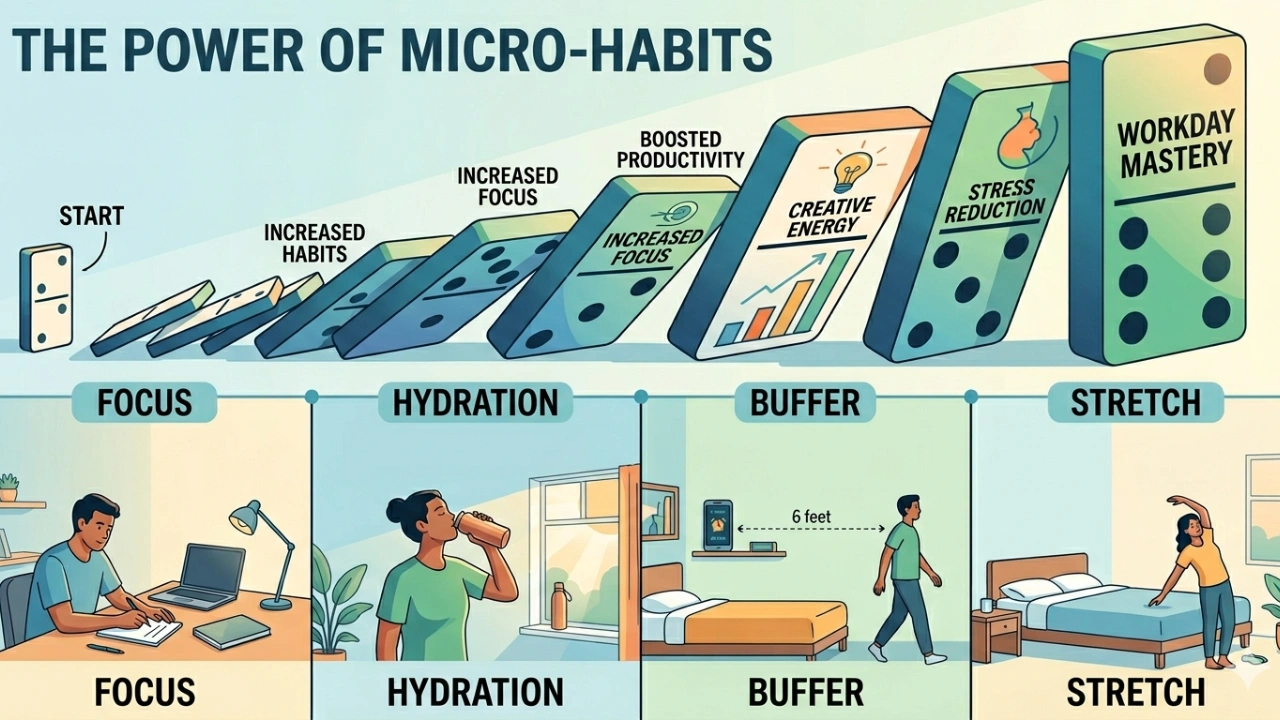
We live in a culture obsessed with massive, overnight transformations. Every January, millions of people flock to gym memberships, promise to read two books a week, or vow to completely overhaul their entire dietary lifestyle. We convince ourselves that to achieve monumental success or to fix a chaotic daily schedule, we must execute monumental changes.
However, more often than not, by the second week of February, reality sets in. The high-energy resolutions collapse under the weight of exhaustion, and we slide straight back into our old, comfortable routines.
The fundamental flaw isn’t a lack of willpower; it is a misunderstanding of human behavioral psychology. Our brains are biologically wired to resist sudden, massive shifts because they interpret them as stressful disruptions.
If you want to permanently reset your productivity, eliminate creative burnout, and reclaim control over your workday, you need to stop thinking big. Instead, you need to master the science of Micro-Habits. By focusing on tiny shifts that take less than two minutes of your morning, you can trigger a massive behavioral domino effect that optimizes your entire day.
What Exactly is a Micro-Habit?
The philosophy of micro-habits—popularized by behavioral researchers like BJ Fogg and authors like James Clear—is built on a simple premise: Make the habit so incredibly small that it is mathematically impossible to say no to it.
For example:
-
Instead of saying, “I will meditate for 30 minutes every morning,” a micro-habit scales it down to: “I will close my eyes and take three deep breaths as soon as I sit at my desk.”
-
Instead of saying, “I will write a 1500-word article before lunch,” a micro-habit scales it down to: “I will open my laptop and write just one single sentence.”
By lowering the barrier to entry down to just 60 or 120 seconds, you bypass the inner mental friction that triggers procrastination. Once you physically start the action, the momentum takes over, and continuing becomes infinitely easier than quitting.
The Neurological Anchor: How Micro-Habits Reset Your Workday
Every single morning, your brain goes through a critical transition phase. The way you spend the first hour of your awake state sets the baseline for your dopamine levels, focus metrics, and stress thresholds for the remaining 15 hours of the day.
When you wake up and immediately reach for your smartphone—scrolling through chaotic news feeds, checking urgent work emails, or viewing curated social updates—you are exposing your brain to a flood of unpredictable micro-stressors. Your mind immediately shifts into a reactive, defensive state. You spend the rest of your day putting out fires, losing focus every ten minutes, and feeling chronically scattered.
Micro-habits break this cycle by introducing intentional anchors. They shift your neurological state from reactive to proactive. Instead of responding to what the world throws at you through your phone screen, you execute a tiny, deliberate action that signals your brain: “We are in control today.”
Also read: What Married Women Do When Home Alone
4 Morning Micro-Habits to Supercharge Your Workday Stability
You do not need an elaborate 2-hour morning ritual involving green juices and sunrise yoga to change your life. Implement these four highly practical, 2-minute micro-habits into your morning framework sequentially to experience an instant productivity lift:
1. The “One-Sentence Intentional Focus” Protocol
Before you touch any digital device, open your email inbox, or check your website’s analytics panels, you need to define your day’s primary victory condition.
-
The Micro-Habit: Keep a physical notepad and a pen right next to your computer or bed. Before turning on your monitor, write down just one single task that must be completed today for the day to be considered successful.
-
The Science: This takes less than 60 seconds, but it utilizes a cognitive phenomenon known as the Selective Attention Filter. By writing down that one core focus, your brain builds a subconscious shield against distractions, helping you filter out low-value background tasks throughout the day.
2. The 90-Second Hydration & Oxygenation Spark
Most people mistake morning grogginess for a lack of caffeine, rushing straight to a coffee machine or tea kettle within five minutes of opening their eyes. In reality, your body has just spent 8 hours losing moisture through respiration, leaving you severely dehydrated.
-
The Micro-Habit: Keep a copper flask or glass of water on your nightstand. Drink it completely within 2 minutes of waking up while standing near a window to catch natural daylight.
-
The Science: Hydrating immediately thins your blood, boosting oxygen delivery to your prefrontal cortex—the area of your brain responsible for logical decision-making and focus. The exposure to natural morning sunlight resets your circadian rhythm, suppressing the sleep hormone melatonin and boosting natural morning cortisol safely.
3. The “Digital-Free Buffer” Zone
The urge to check notifications immediately upon waking is a modern behavioral addiction driven by cheap dopamine loops. Breaking it directly requires an environmental boundary, not just mental strength.
-
The Micro-Habit: Plug your smartphone charger into an outlet that is at least five to six feet away from your mattress. When your morning alarm goes off, walk over, turn it off, and don’t open a single social media app for the next two minutes.
-
The Science: This simple physical distance creates what behavioral economists call “friction.” By keeping your phone out of arm’s reach during your waking moments, you prevent your brain from slipping into an instant state of information overload, protecting your morning attention span.
4. The 60-Second Physical Calibration
Sitting in a corporate chair or hunched over a laptop for hours ruins spinal alignment, reduces lung capacity, and causes muscle stiffness that translates directly into mental fatigue.
-
The Micro-Habit: The moment you stand up from your bed, stretch your arms straight toward the ceiling, take a deep inhale, and gently touch your toes for 60 seconds.
-
The Science: This basic physical extension decompresses your spinal vertebrae and triggers the release of nitric oxide into your bloodstream, expanding blood vessels and increasing physical alertness without putting your body under intense workout stress.
Summary as per me: Building Your Micro-Habit Compound Interest
In the world of finance, small amounts of money invested consistently over time accumulate massive wealth due to compound interest. Habits work exactly the same way. A 2-minute micro-habit might seem inconsequential today, but when repeated for 30, 60, or 90 days straight, it fundamentally rewires your neural pathways. Stop waiting for the perfect moment to execute a massive lifestyle change. Start with two minutes tomorrow morning, lock in your momentum, and watch your entire workday align with absolute ease.
Here is how to rewire your brain for focus before your workday even begins. Check out our latest masterclass:
How Micro-Habits Can Reset Your Morning Routine And Workday Focushttps://t.co/hngQ0FCXuv#ProductivityTips #MicroHabits— genxsoft (@genxsoftinfo) June 9, 2026